Mattress compatibility
How to Check Mattress Flexibility Before Choosing an Articulating Base
An articulating base can raise the head or feet of a bed with the touch of a button. Whether the mattress can follow that movement night after night is a separate question. Check its construction, manufacturer guidance, and warranty before making the change.
The appeal of an adjustable sleep surface is easy to understand. A raised head can make reading more comfortable; an elevated leg position may suit a person’s preferred way to rest. But a base that moves is only half of the system. The mattress above it must bend, settle, and return to a flat position without its layers shifting, its support becoming uneven, or its materials being placed under stress they were not designed to bear.
That compatibility is not determined by one label or one material. “Latex,” “foam,” and “hybrid” describe broad families of construction, not a guarantee that a particular mattress will work with a particular articulating base. Thickness, internal support, adhesives, quilting, edge structure, and the base’s movement pattern all matter. The most reliable first step is not a bend test at home. It is to identify the exact mattress model and ask its manufacturer whether it is approved for repeated articulation.
This guide explains what to inspect, why latex mattresses deserve a closer look, how to verify fit and warranty terms, and what to ask before setting up a flexible sleep surface. It is a practical checklist, not a substitute for a manufacturer’s instructions or advice from a qualified health professional.
What an articulating base asks a mattress to do
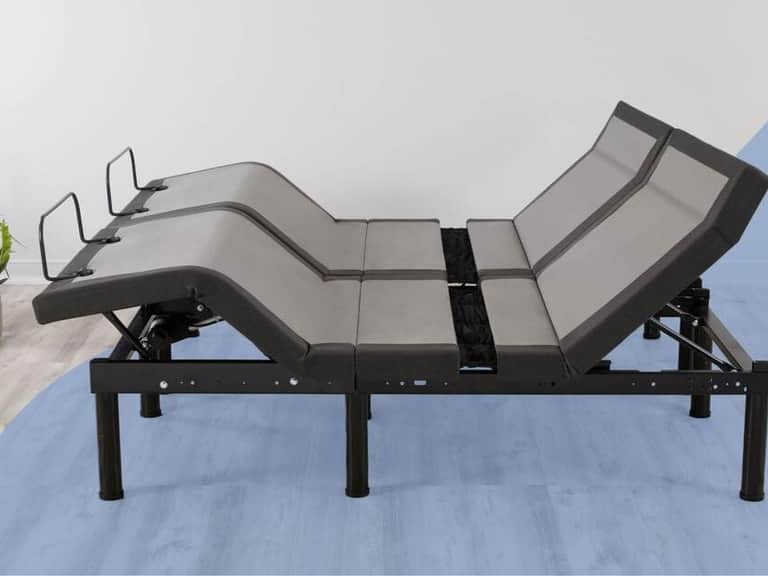
Unlike a fixed foundation, an articulating base changes shape. Depending on its design, it may lift the upper body, raise the legs, or move more than one section at once. The mattress must conform to those changes while remaining supported across the moving platform. It may be asked to flex repeatedly at similar points, sometimes several times in a day.
That movement creates a different set of demands from ordinary use on a level foundation. A mattress might feel comfortable and sturdy when flat yet resist bending, bow between support points, or separate internally when angled. Another may flex readily but slide on the platform, creating a fit problem rather than a material failure. “Flexible” therefore means more than “soft.” It describes how the entire mattress assembly responds to repeated changes in shape.
There is no universal visual test that can confirm compatibility. A mattress that bends by hand in a showroom may not be built for motorized movement over years of use. Conversely, a mattress that feels firm on a flat bed may still be approved for an adjustable base if its construction is engineered for that purpose. Model-specific guidance matters more than appearance or a quick experiment.
Start with the manufacturer’s compatibility guidance
Before measuring the room or shopping for features, find the mattress label, receipt, order confirmation, or product documentation. Record the exact model name, size, approximate purchase date, and any generation or version information. Mattress lines can change over time; a current product page may not describe an older model accurately.
Then consult the manufacturer’s official documentation or customer service team. Look for an explicit statement that the mattress is compatible with an articulating or adjustable base. If the wording is unclear, ask directly whether the exact model is approved for repeated powered movement and whether there are restrictions on the type of base.
Keep the response with your purchase records. If you receive an answer by phone, note the date, the department you contacted, and what was confirmed. A clear written response is particularly useful when a warranty distinguishes between use on an approved foundation and use on an unsupported or incompatible platform.
- Is this exact mattress model designed for use on an articulating base?
- Are there limits on the base’s movement, angle, or range of positions?
- Does the mattress require a particular platform, retainer bar, or support configuration?
- Can the mattress be used on a split or dual-adjusting base?
- Does use on an adjustable base change warranty coverage or care requirements?
- Are there exclusions for damage related to bending, sliding, or uneven support?
Do not treat a retailer’s general assurance as a substitute for model-specific manufacturer guidance. A broad statement such as “most foam beds work” may be well intentioned, but it does not settle the question for a mattress with unusual layers, a reinforced perimeter, or a specific warranty condition.
Read the construction, not just the material name
Product descriptions often lead with the most recognizable material: latex, memory foam, innerspring, or hybrid. Underneath that headline may be a more complicated structure. A mattress can combine several foam layers, a fabric cover, quilting, adhesives, transition materials, coils, and reinforced edges. Each layer can behave differently when the bed bends.
Construction details worth finding include the core type, layer order, approximate thickness, whether the mattress contains coils, and whether the edges use rigid reinforcement. Also note whether the cover is tightly quilted or attached in a way that could limit movement. A thick comfort layer does not automatically prevent articulation, and a thin mattress is not automatically compatible. The point is to gather enough information for the manufacturer to assess the actual design.
Coil systems vary, as do foam formulations and mattress assembly methods. Some designs are built to flex with an adjustable platform; others may not be. Likewise, the word “hybrid” does not tell you whether a specific coil unit or perimeter structure can accommodate the base’s movement. Ask about the complete mattress, not only its most prominent component.
Look for practical signs after setup, too, while following the manufacturer’s operating instructions. The mattress should rest evenly on the platform when flat and remain supported through approved positions. Unexpected gaps, pronounced bowing, shifting, bunching, or a cover pulled taut in one area are reasons to stop and investigate. They are not proof of a defect by themselves, but they should not be dismissed as normal without guidance.
How latex mattress layers may respond
Latex is often chosen for its resilient, spring-like feel. In a mattress, it may appear as a single slab, several stacked layers, or one component in a larger construction. Those arrangements can respond differently when the platform changes shape. The word “latex” alone does not establish whether a mattress is suitable for an articulating base.
Consider the thickness and firmness of each layer, how the layers are connected, and what support sits below them. A layered mattress may have components that are held in place by a cover, joined in another way, or designed to be rearranged. When angled, these parts need to stay appropriately aligned. If they shift relative to one another, the sleeper may notice unevenness or the mattress may not settle back as intended.
Firmness is also easy to misread. A firmer latex layer may feel less yielding under the hand, but the full mattress’s ability to flex depends on the whole assembly and the geometry of the base. Conversely, a softer surface does not prove that the core can tolerate repeated bending. Avoid pressing, folding, or forcing a mattress to see how much it will move; that kind of test may put stress on the product and cannot replace an approval from its maker.
For a latex model, ask whether its construction is approved for articulation in the size you own. If the mattress has multiple layers, ask whether they should remain in a particular order or orientation. Confirm whether a split configuration is permitted, and whether the maker requires specific support under the center or across the full platform. These answers can matter as much as the material itself.
Check the base and mattress as a matched system
Compatibility runs in both directions. A mattress can be approved for adjustable use yet still be a poor fit for a particular base if dimensions, retainers, or support requirements do not match. Before purchase or installation, compare the mattress size with the base size and review the base maker’s instructions. A king mattress, for example, may not behave like a split-king arrangement in which each side moves independently.
Confirm how the mattress is held in position. Some bases use a foot retainer or other retaining mechanism; others rely on platform surfaces and the system’s design. The mattress should not migrate as the base moves. Do not add straps, improvised fasteners, or accessories unless the manufacturer approves them. An attachment that appears to solve sliding could interfere with movement or place pressure on the cover or seams.
Check the surface beneath the mattress. The base should be assembled correctly, positioned on a stable floor or approved frame, and operated within its stated limits. If it is installed inside an existing bed frame, verify that the frame allows the base to move freely and that cables, bedding, or surrounding furniture cannot become trapped. Follow the instructions for clearance, weight limits, and electrical connections.
When two manufacturers are involved, ask both. The mattress maker can speak to the mattress; the base maker can explain platform dimensions, articulation, and retaining features. If either company identifies a restriction, resolve it before regular use rather than assuming one product’s approval covers every possible combination.
Warranty language deserves a close reading
A warranty is not a promise that a mattress will perform identically on every foundation. It sets out the conditions under which the manufacturer may repair, replace, or otherwise address a covered issue. Read the section about foundations, support surfaces, and adjustable bases before changing how the mattress is used.
Look for requirements such as a solid or slatted surface, minimum support points, center support for larger sizes, or specific spacing between slats. Check whether an articulating base is named explicitly, and whether the warranty distinguishes between approved and unapproved models. Also note the conditions for sagging, body impressions, cover damage, and structural failure. Those terms can be defined differently by different makers.
Keep the warranty, product tag information, proof of purchase, and any compatibility confirmation together. Photographing the setup after installation can help document that the mattress is properly supported, though photographs do not guarantee a claim outcome. If a concern arises, stop using positions that appear to cause strain and contact the manufacturer promptly. Avoid taking the mattress apart or modifying it unless directed to do so.
Warranty coverage and compatibility are related but not identical questions. A mattress may physically move on a base without damage becoming immediately visible, yet the use could still fall outside stated terms. Equally, a warranty may permit a compatible adjustable base while requiring the owner to follow particular setup instructions. Confirm both points rather than relying on a single yes-or-no answer.
A careful setup, step by step
Once compatibility is confirmed, treat installation as a process rather than a one-time lift-and-switch. Clear the area, assemble the base according to its manual, and check that the mattress is oriented correctly. If the product is heavy or difficult to handle, use appropriate assistance; do not risk injury trying to position it alone.
- Inspect before moving. Note the mattress’s current condition, including visible dips, damaged seams, or unusual sounds. Existing problems should not be confused with effects of the new setup.
- Verify measurements. Confirm that the mattress and base have matching dimensions and that any split configuration is correct.
- Place the mattress as instructed. Use the manufacturer’s recommended orientation and retaining components. Do not force corners or edges into position.
- Test movement without a sleeper. Operate the base through its approved positions while watching for shifting, obstruction, or unusual resistance. Keep hands, cords, and bedding clear of moving parts.
- Return it to flat and inspect. Check whether the mattress has settled evenly and whether any layer, cover, or corner appears displaced.
- Recheck after ordinary use. Look for recurring movement or changes in alignment, and follow any recommended maintenance schedule.
Do not exceed the base’s stated limits or use positions that the manufacturer has not approved. A powered base should not be used as a diagnostic tool to find the mattress’s breaking point. If movement sounds strained, the mattress shifts substantially, or the platform does not operate normally, stop and consult the relevant manufacturer.
Common assumptions that can lead to trouble
“If it bends once, it is compatible.” A one-time bend says little about repeated motorized movement. The mattress may flex briefly yet be unsuitable for sustained use in changing positions.
“All foam mattresses are adjustable.” Foam is a broad category, and mattress assemblies differ. Construction, cover, thickness, support core, and warranty conditions still need to be checked.
“A latex mattress is naturally flexible enough.” Latex can be resilient, but the material name does not answer how the complete mattress is built or whether its manufacturer approves articulation.
“The base fits the bed frame, so the mattress must fit too.” Frame clearance and mattress compatibility are separate questions. Verify both, including the mattress’s ability to stay positioned on the moving platform.
“The warranty covers anything that happens.” Warranty terms have conditions and exclusions. Read them before use, and ask the maker to clarify ambiguous language in writing.
A quick checklist before you choose
- You have identified the exact mattress model and version.
- The mattress manufacturer confirms compatibility with an articulating base.
- The base maker confirms the mattress size and configuration are appropriate.
- You understand any restrictions on angle, movement, or split operation.
- The mattress warranty requirements for foundations and support are clear.
- Any needed retaining bar or approved attachment is included or specified.
- The base fits the room and existing bed frame without obstructing movement.
- You know how to stop operation and whom to contact if the mattress shifts or the base behaves unusually.
If one of these points is unresolved, pause before purchase or installation. A few specific questions can prevent an expensive mismatch and make it easier to distinguish a genuine comfort issue from a setup problem.
The bottom line
Choosing an articulating base is not simply a decision about motors, remote controls, or preferred sleeping positions. It is a compatibility decision involving the base, the mattress, the support underneath, and the instructions that govern their use. A mattress must do more than bend: it needs to flex repeatedly while staying supported, aligned, and secure.
For latex mattresses in particular, look beyond the material label. Ask about the full layer construction, firmness and thickness, how components are held together, and whether the exact model is approved for articulation. Then verify the base’s fit and read the warranty conditions before setting everything up.
There is no need to guess from a showroom demonstration or a broad product category. The strongest answer comes from model-specific guidance, clear warranty terms, and a careful installation. With those pieces in place, a flexible sleep surface can be chosen with a better understanding of what it asks the mattress to do—and what the mattress is actually designed to handle.