Bedding · Adjustable bed compatibility
Mattress Thickness, Articulation, and Warranty Fine Print
An adjustable base can change the shape of a bed with the touch of a button. The mattress on top has to move with it. Thickness matters, but it is only one part of the compatibility question: construction, flexibility, dimensions, and warranty terms all help determine whether a particular pairing will work as intended.
A mattress is usually chosen by how it feels when it lies flat. On an articulating base, that is only half the story. The mattress must also bend as the base raises the head, lifts the legs, or moves both sections at once. If it resists those movements, the result may be reduced articulation, shifting bedding, uncomfortable pressure, or strain on the mattress and base.
Thickness can influence that movement, but there is no universal maximum thickness that applies to every adjustable bed. A relatively slim mattress may still resist bending because of its internal construction. A thicker mattress may articulate comfortably if its materials and design are intended for a moving foundation. The practical answer is found in the specifications for both products—and in the warranty language that governs their use together.
For shoppers considering an organic mattress, the same principle applies. Natural and organic materials do not automatically make a mattress compatible or incompatible with an adjustable base. What matters is the complete construction: the layers, their arrangement, the mattress’s flexibility, and the manufacturer’s instructions.
Why thickness is not the whole measurement
Thickness describes the mattress’s height from its bottom surface to its top. It does not tell you how readily the mattress can curve at the points where an adjustable base bends. Two mattresses with the same stated profile can behave differently because their cores, comfort layers, quilting, and edge structures are not alike.
A mattress with a stiff, continuous support core may resist a sharp bend. Another mattress of similar thickness, built with flexible components and intended for articulation, may follow the base more easily. Even within the same material family, construction varies: latex can be arranged in different layers and firmnesses; foam can vary in density and composition; coil units differ in design and how they are supported. A label alone cannot settle the question.
More depth can mean more material that has to flex, and a tall, heavy mattress may place different demands on a base than a lighter, thinner one. But neither observation is a verdict. The base maker may set a specific supported thickness range, while the mattress maker may set separate requirements for its product. Compatibility should be checked against both manufacturers’ guidance rather than inferred from appearance or a general rule of thumb.
Look for the mattress’s exact finished height, not an approximate marketing description. If the listed height includes a pillow top, quilted panel, or other comfort component, confirm how the manufacturer defines the measurement. Also note whether the model is available in multiple configurations: the same product name can cover different heights, firmnesses, or sizes.
How articulation affects a mattress
An adjustable base raises and lowers sections of its deck. As the head or foot rises, the mattress must change shape over the moving sections while remaining supported. The amount and location of the bend depend on the base’s design and selected position. A mattress that is too rigid for that motion may not follow the deck smoothly; one that is well matched can move with it while preserving a reasonably even sleep surface.
Compatibility is not just about whether the motor can lift the mattress. A base may move under load while the mattress shifts, bows, develops a gap, or feels different than expected. The bed’s total load—including mattress, bedding, and occupants—also matters. Manufacturers may publish weight limits or other operating conditions; those figures should be reviewed rather than assumed.
Mattress retention features are another detail. Some bases use a retainer bar at the foot, while others rely on different designs. Confirm that the mattress can be secured as intended and that its dimensions suit the base. A mattress that creeps during repeated adjustment can disrupt bedding and may create a setup the manufacturer does not recommend.
For split configurations, confirm the precise arrangement. A split king, for example, generally uses two independently moving sides, so the mattress size and construction must correspond to the base’s layout. A single mattress placed over a divided platform may behave differently from two separate mattresses. Do not assume that a familiar bed size means every mattress configuration will be supported.
Organic materials and flexible construction
“Organic” describes how certain materials are sourced or certified; it does not describe how a mattress bends. A mattress can contain certified organic cotton, wool, or latex and still have a construction that requires specific foundation support. Conversely, a mattress using conventional materials may be designed for adjustable-base use. Material credentials and articulation performance are separate questions, and both deserve attention.
Natural latex is often discussed in adjustable-bed shopping because latex can be resilient and responsive, but the word alone is not a compatibility guarantee. Layer thickness, firmness, bonding, and the structure of the overall mattress all affect how the finished product moves. A hybrid mattress with coils and natural comfort layers has still another construction to evaluate. Ask for model-specific guidance, not a broad assurance based only on a material description.
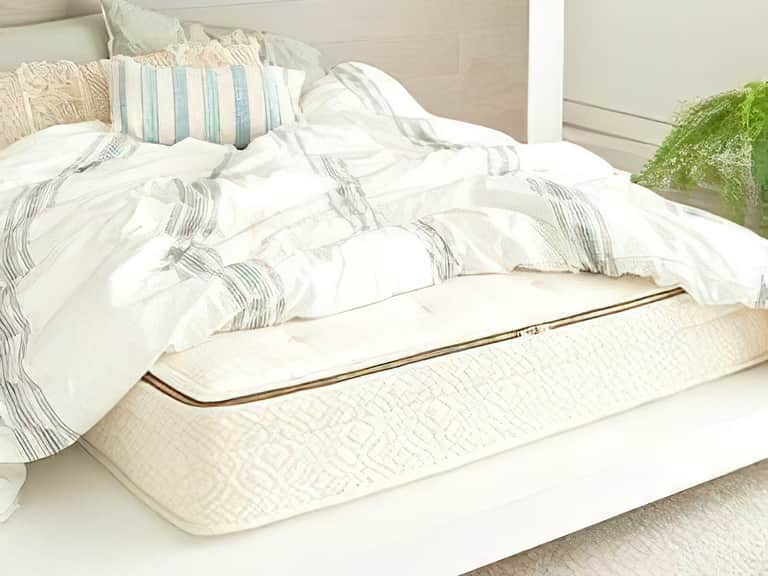
Consider the Naturepedic Azure Hybrid Organic Mattress as an example of why specifications matter. Its listed construction is a 10-inch profile with wrapped coils and organic Dunlop latex. That description gives useful information about materials and layers, but it does not by itself establish compatibility with every adjustable base. Before pairing it with a moving foundation, confirm the manufacturer’s current instructions for that exact model and the base’s requirements. Review the [Naturepedic Azure Hybrid Organic Mattress](/products/naturepedic-azure-hybrid-organic-mattress-277) specifications as part of that check.
Certifications can help verify particular claims about materials or processing, but they should not be treated as a substitute for a compatibility statement. A certification does not necessarily test articulation, motor performance, bending durability, or warranty coverage on an adjustable foundation. Keep those questions distinct when comparing products.
The warranty language that deserves a close read
A mattress warranty is not a general promise that every possible use will be covered. It typically sets conditions and exclusions, and using a mattress on an adjustable base may be addressed specifically. Before purchase, read the warranty for the mattress and the base. If either document is unclear, ask the manufacturer to clarify the exact combination in writing.
Search for terms such as “adjustable foundation,” “articulating base,” “power base,” “flexible foundation,” and “improper support.” Read the surrounding paragraph, not just the phrase. The warranty may permit use with an adjustable base only if the base meets stated conditions, such as having an appropriate surface, operating within weight limits, or supporting the mattress in a specified way.
Other clauses may concern the foundation generally. A warranty might distinguish between a compatible adjustable base and a foundation with widely spaced slats, an uneven surface, or insufficient support. It may also explain what counts as a covered defect compared with expected softening, normal compression, or damage from misuse. Terms vary by maker and model; do not assume that one brand’s policy applies to another.
Check the base warranty as well. It may include limits on the supported mattress size, weight, thickness, or construction. It can also describe proper installation, clearance, use of a bed frame, and maintenance requirements. A mattress being approved for adjustable use does not automatically mean every base will accept it, and a base’s ability to move does not automatically preserve the mattress warranty.
Keep a copy of the product specifications, warranty documents, and any written response from customer support. Record model names and, where available, product or serial numbers. If a question arises later, precise documentation is more useful than relying on a verbal summary or a retailer’s general description.
A practical compatibility checklist
Before ordering, compare the mattress and base using the exact models and sizes under consideration. A short checklist can prevent an avoidable mismatch:
- Confirm the mattress height. Use the published finished thickness for the specific model and size.
- Check the base’s stated range. Look for any maximum or minimum mattress thickness, size, or weight guidance.
- Verify articulation approval. Seek a clear statement that the mattress is designed or permitted for use on an adjustable base.
- Review the construction. Note whether the mattress uses foam, latex, coils, or multiple layers, and ask how the complete assembly behaves when articulated.
- Read both warranties. Identify exclusions and conditions relating to moving foundations, support surfaces, weight, and installation.
- Match the size and configuration. Confirm whether the setup requires one mattress or two, especially with split bases.
- Ask about retention and fit. Check how the mattress is secured and whether its dimensions work with the base and any surrounding bed frame.
- Clarify the return window. Understand what happens if the combination does not work in practice, including any fees or restrictions.
Retail descriptions often compress a complicated setup into a few phrases: “works with most frames,” “flexible design,” or “adjustable compatible.” Those statements may be useful starting points, but they can refer to different things. A base that fits inside many bed frames is not necessarily compatible with every mattress, and a mattress that bends is not necessarily covered by every warranty when used on a moving base.
Questions to ask before you buy
When specifications leave room for interpretation, ask concrete questions. Instead of asking whether a mattress is “adjustable-bed friendly,” give the manufacturer the exact base model, mattress model, size, and profile. Ask whether the proposed combination is approved and whether that use affects warranty coverage.
Useful follow-up questions include: Is there a stated thickness limit? Are there restrictions on the base’s support surface or slat spacing? Does the mattress need a particular retainer or platform? Is a split configuration required for the selected size? Are there limits on how frequently the base may be adjusted or on the angles it may reach? The answer may vary by product, so request guidance tied to the products you plan to purchase.
If you are purchasing through a retailer, distinguish retailer return policies from manufacturer warranties. A retailer may offer a trial or return option, but that does not necessarily expand the manufacturer’s warranty. Check the applicable dates, conditions, pickup arrangements, and fees before delivery. Ask what happens if the mattress is compatible on paper but does not behave as expected in your own setup.
After installation: inspect the setup thoughtfully
Once the mattress is installed, follow the base maker’s operating instructions and begin with a clear area around the moving parts. Raise and lower the sections gradually, observing whether the mattress stays in position and follows the deck without unusual resistance. Do not force a base, bypass a safety feature, or continue operation if the manufacturer’s instructions suggest stopping.
Pay attention to practical signs: the mattress sliding away from the retainer, bedding pulling tight, a visible separation between mattress and platform, or a change in movement that seems inconsistent with normal operation. These observations do not, on their own, diagnose a defect, but they are reasons to consult the manufacturer’s instructions or support team. Avoid attempting repairs or alterations that could affect safety or warranty coverage.
Recheck the setup if you change the mattress, add a topper, replace the base, or move the components into a different frame. A topper may not alter the mattress’s formal thickness, but it can shift or behave differently as the bed moves. Any new layer should be secured and used in a way that both manufacturers permit.
What the fine print is really asking
Warranty language can feel like an obstacle, but it is often a record of the conditions a product was designed and tested to meet. The important task is to translate those conditions into a clear answer for one particular bed: this mattress, on this base, at this size, used in this configuration.
Thickness is an easy number to compare, which is why it attracts attention. Yet articulation depends on a more complete set of facts. A suitable profile, flexible construction, compatible dimensions, appropriate support, and aligned warranty terms matter together. No single feature—organic content included—can replace that check.
The most dependable buying decision is therefore not based on a universal thickness rule or a broad promise of compatibility. It comes from matching product-specific specifications, confirming the approved setup, and keeping the documentation. That small investment of attention can help protect both the movement of the base and the support of the mattress, without leaving warranty coverage to guesswork.